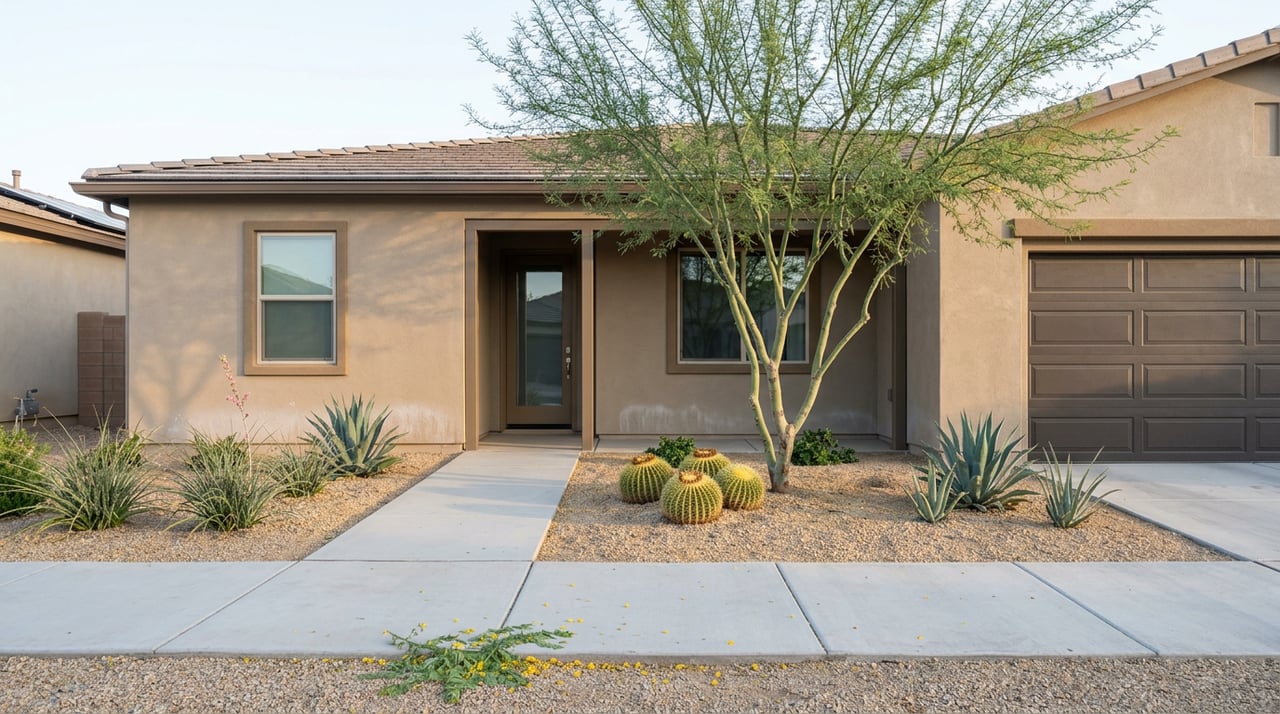
Glendale Home Inspections by Neighborhood: Old vs. New Homes
September 24, 2026
September 24, 2026
A buyer under contract on a new build in Stonehaven, the master-planned community going up around 8800 W Maryland Ave near Westgate, tells their agent they don't need the full inspection period. The house was built this year. What could possibly be wrong with it?
A few miles east, a buyer under contract on a 1930s craftsman bungalow in Catlin Court gets an inspection report flagging original wiring and a section of galvanized plumbing, and walks. The house feels like a liability the moment the report lands in their inbox.
Both buyers are reading the calendar instead of the house. In Glendale, the age of a home tells you what kind of inspection surprise you're likely to get, not whether you're going to get one.
The instinct to treat "new" as "safe" and "old" as "risky" makes sense on paper. It falls apart once you look at what local inspectors actually find, neighborhood by neighborhood, because the failure categories don't rank by severity. They rank by type. A 100-year-old bungalow fails in ways that are well understood and often cheap to remedy. A brand-new production home fails in ways that are harder to see and, if missed, more expensive to unwind once drywall and landscaping cover them up.
Treating a construction-era mismatch as a dealbreaker, or treating a builder's warranty as a substitute for your own inspector, both end the same way: a buyer who either overpays for peace of mind or underpays for problems that surface eighteen months later.
Catlin Court exists because a Wisconsin businessman named Otto Hansen platted 80 acres in 1914 and named it after his wife's maiden name. The Catlin Court Historic District grew between 1914 and 1942, was added to the National Register of Historic Places on June 9, 1992, and today holds more than 80 buildings, nearly half of them Craftsman Bungalow style with a scattering of Spanish Eclectic homes from a late-1930s building wave.
That age profile tells an inspector exactly where to look. Original electrical wiring, cast iron or galvanized plumbing, foundation settling, and roof framing that predates current code are the standard flags in this pocket of Glendale, according to home inspectors who work the area regularly. None of that is unusual for a house built before 1942. It is also, in most cases, a known and priced repair rather than a mystery.
The friction buyers don't expect: part of Catlin Court carries Glendale's Historic Preservation overlay, and exterior work inside that boundary goes through the city's Certificate of No Effect process under Section 6.400 of the zoning ordinance before you can swap siding or repaint. The full text of that preservation guidance spells out that new exterior materials and colors have to match the neighborhood, and it discourages bright, high-contrast paint choices outright. If your inspection turns up peeling trim or aging siding on an HP-overlay property, the fix isn't just a contractor call. It's a city review first.
Stonehaven is the opposite housing stock in the same city. The 1,200-home master plan near Westgate has Lennar, Pulte, and Taylor Morrison all building inside the same community, with pricing that ran from the $400s into the $675,000 range across builders as of this spring's sales cycle. EV-ready garages come standard. You can walk to the entertainment district.
None of that tells you whether the drainage grading around the foundation was done correctly, whether every wall penetration was sealed before stucco went on, or whether the HVAC system was actually commissioned and balanced rather than just switched on for the final walkthrough. Local inspectors who work new construction in the Camelback Ranch and Loop 303 corridor describe exactly these items as their most common findings: builder-phase oversights, grading issues, and mechanical systems that were installed but not properly verified. A one-year builder warranty covers a lot, but it only covers what gets caught.
The counterintuitive part is that a 2026-built home in Stonehaven and a 1930s bungalow in Catlin Court can generate inspection reports of similar length. They just itemize completely different problems.
| Where | What Usually Turns Up | Typical Fix Tier |
|---|---|---|
| Catlin Court / downtown grid (built 1914-1942) | Original wiring, cast iron or galvanized plumbing, older roof framing | Known and scoped, often modest |
| Mid-century neighborhoods (built 1950s-1990s) | Aging panel boxes, roof underlayment near end of life, HVAC approaching replacement age | Moderate, tied to system age |
| Arrowhead Ranch (established golf and lake community, 85308/85310) | Aging mechanical systems layered under higher price points | Varies widely by prior maintenance |
| Stonehaven and other new construction (Camelback Ranch corridor, Loop 303) | Grading, unsealed penetrations, mechanical systems not fully commissioned | Can be costly if missed before drywall closes |
Arrowhead Ranch sits in its own category. It's one of Glendale's most desirable addresses, built around a private lake and golf course, and homes there traded between roughly $575,000 and $920,000 as of May 2026. At that price point, buyers assume a higher standard of upkeep. The inspection risk isn't the neighborhood's age so much as how well any individual seller has maintained systems that are now old enough to matter, which is exactly the kind of thing a general assumption about a "nice neighborhood" won't catch and a line-by-line inspection will.
None of this matters much if the market has priced out your ability to negotiate. It hasn't, not right now.
Trackers disagree on the exact pace of Glendale's market this summer, which is itself useful information. Redfin's three-month window ending June 2026 put the median sale price at $435,000 with homes averaging 57 days on market. Zillow's July 31, 2026 update showed the average home value at $405,789, essentially flat over the past year. A separate tracker's July 2026 snapshot of six months of closings found the more telling number: Glendale's active listings were asking a median of $457,500 while the homes that actually closed sold for a median of $405,000, a gap of more than $50,000.
That gap doesn't mean sellers are desperate. It usually means the mix of homes currently listed skews different from the mix that's actually trading. But it also means a seller asking top dollar has less room to hold that number once your inspector's report lands on the table, whether the flagged item is knob-and-tube wiring in a 1930s bungalow or a grading problem on a house that closed six months ago in Stonehaven. Days on market in the 40s to upper 50s, depending on the source, is not a market where buyers need to waive contingencies to compete. It's a market where the inspection period is still one of the few points of leverage you have, provided you know which kind of report to expect before you're reading it under a deadline.
Should I skip the inspection on a new build in Stonehaven? No. New construction can have its own category of defects, mainly grading, sealing, and mechanical commissioning, so buyers may want an independent inspection in addition to the builder's final walkthrough.
Is knob-and-tube wiring or galvanized plumbing a reason to walk away from a Catlin Court bungalow? Not on its own. These are known, scoped issues in homes from this era. Get a repair estimate before you decide whether it changes the deal.
How long should my inspection period be in Glendale right now? Long enough to get a second opinion on anything unusual. With days on market running from the low 40s to upper 50s across different trackers this year, you are not in a market that requires you to compress your contingency to win the house.
Whichever pocket of Glendale you're buying into, from a hundred-year-old bungalow off Glendale Avenue to a framed-last-month home near Westgate, the inspection report is telling you something specific about that home's era, not a generic verdict on whether it's a good buy. If you want a second read on what a report is actually saying before you decide what to negotiate, Erica Cherry Homes can walk through it with you line by line. Schedule your free consultation and bring the inspection report with you.
This article is general information, not legal, tax or financial advice. Consult a qualified professional about your situation.
Stay up to date on the latest real estate trends.

Looking to buy, sell, or just have a question? I'm always available to help and would love to work with you. Contact me today to start your home searching journey!